Choosing the right 12V TV for your RV starts with understanding how you’ll use it. If you frequently camp off-grid, a 12V television can run from a compatible RV battery system without an inverter. But if you usually have shore power, a regular smart TV may offer better value.
Beyond the power source, screen size, energy consumption, viewing angles, and smart features all affect how well a TV works in your motorhome. A model that looks good on paper may not be the best fit for a small camper bedroom or a larger RV lounge.
Here’s what to look for when choosing a 12V RV TV, along with practical comparisons to help you find the right option for your space, power setup, and budget.
Should You Buy a 12V or 120V TV for Your RV?
The main difference between a 12V RV television and a regular 120V TV is how they receive power. A 12V model designed for RV use can connect to a compatible DC power supply, while a household 120V TV needs shore power, a generator, or an inverter that converts battery power into AC electricity.
For RV owners who frequently camp off-grid, avoiding an inverter can simplify their setup and reduce energy lost during power conversion. However, regular household TVs generally offer more choices in screen size, smart features, and price.
| Feature | 12V RV TV | Regular 120V TV |
|---|---|---|
| Power Source | Compatible 12V DC system | Shore power or inverter |
| Off-Grid Use | Direct DC operation | Usually requires an inverter |
| Battery Efficiency | Avoids inverter losses | Depends on TV power use and inverter efficiency |
| Purchase Price | Often more expensive | Generally more affordable |
| Smart Features | Available, but fewer choices | Wider selection of operating systems and apps |
| Best For | Frequent boondocking and off-grid camping | RVs with regular electrical hookups |
If you regularly spend nights away from campgrounds, a 12V TV is worth considering. You can watch television without turning on an inverter solely for entertainment. Some inverters also produce noticeable cooling-fan noise, which can be distracting when watching TV in a quiet camper bedroom.
On the other hand, a 120V TV may be the better purchase if your motorhome already has an inverter running other equipment. In that situation, the additional energy needed to power a television may be relatively small, depending on the inverter’s efficiency and the TV’s actual power consumption.
There’s also a third possibility. Some household TVs use an external power adapter and operate internally on DC power, sometimes at 19V. A properly matched regulated DC converter may allow certain models to operate without an AC inverter. However, this requires checking voltage, current, connector polarity, and manufacturer requirements. It’s not a plug-and-play solution for most buyers.
The practical choice: If you frequently camp off-grid and want a simpler power setup, consider a dedicated 12V TV. If you mostly use shore power, compare regular smart TVs before paying extra for an RV-specific model.
How Do You Choose the Right 12V TV for Your RV?
Once you’ve decided that a 12V television fits your camping style, the next step is identifying which specifications actually matter.
A television that looks good in a product listing may still be inconvenient inside a camper. It might have the wrong power connection, take up too much cabinet space, or provide a poor picture when viewed from the dinette. The following four factors will help you narrow your options without getting lost in technical specifications.
Power Compatibility and Energy Use
Power compatibility should be your first check when buying a 12 volt television for an RV. Not every product labeled “12V” can safely handle the same input voltage range.
An RV’s 12V electrical system doesn’t always operate at exactly 12 volts. Battery voltage changes during charging and use, so the television must support the actual voltage range of your RV’s power system.
Some RV televisions accept a wider range of DC voltages, while others have more limited requirements. Check the manufacturer’s specifications rather than assuming every RV TV supports the same range.
Before purchasing, confirm three things:
- DC input range: Is the TV compatible with your RV’s electrical system?
- Power consumption: How much electricity will it use during viewing?
- Power connection: Does it include the correct cable or adapter, and what electrical protection features are specified?
Power consumption matters particularly if you rely on batteries and solar panels. A 30W television running for three hours uses approximately 90Wh of electricity, before additional losses. At a nominal 12V, that’s roughly 7.5Ah of battery capacity.
For occasional viewing, that may be manageable. But if you’re also running a refrigerator, lights, fans, and other electronics, the TV becomes part of your overall daily energy budget. Remember that a manufacturer’s maximum power rating isn’t necessarily what the television consumes during every hour of use.
Screen Size, Resolution, and Viewing Angle
Most RV owners don’t need an enormous television. A smaller display often provides a comfortable viewing experience in a camper bedroom or compact living area while leaving enough room for cabinets, windows, and other furniture.
The right screen size depends on where the TV will be installed and how far away you’ll sit.
| RV Location | Suggested Screen Size | What Matters Most |
|---|---|---|
| Compact camper or bunk area | 19–22 inches | Limited mounting space and low weight |
| Motorhome bedroom | 22–24 inches | Comfortable viewing distance and positioning |
| RV lounge or dinette | 24–32 inches | Viewing angles and adjustable mounting |
| Larger motorhome living area | 32 inches or larger | Available space, viewing distance, and secure mounting |
These are starting points rather than strict rules. A 32-inch TV might fit perfectly in one motorhome but block a cabinet door in another. Always measure the available width and height, including clearance for the mounting bracket.
Resolution is another consideration. You’ll find both 720p and 1080p Full HD televisions in the compact RV market. At smaller screen sizes and normal viewing distances, a good 720p display may be acceptable, although 1080p generally offers sharper detail.
Be careful with product descriptions that advertise “1080p support.” Some TVs can accept a 1080p signal even though their screens have a lower native resolution. If picture clarity matters, check the actual screen resolution rather than the supported input formats.
Viewing angle is just as important, especially in a motorhome lounge. Two people may watch the same TV from different seating positions, and a narrow viewing angle can make the picture look clear from one seat but washed out from another.
For a TV mounted in a corner or beside the bed, prioritize a display that maintains a clear picture from your usual viewing positions.
Smart Features and Entertainment Options
Not every 12V RV TV comes with built-in smart features, and you don’t necessarily need them. Some models offer Google TV or other streaming platforms, while simpler televisions focus on local broadcasts and HDMI connectivity.
If you already own a Roku or Fire TV Stick, a basic 12V television with a compatible HDMI connection may be enough. Just make sure your streaming device has a suitable power source and that you’ll have internet access when you need it.
You don’t necessarily need built-in smart features, either. A regular 12V TV with an HDMI port can work with a compatible Roku, Fire TV Stick, or another streaming device. This can be practical if you already own a streaming stick or prefer its interface.
The bigger question is how you plan to watch television when internet access is limited.
Campground Wi-Fi may be slow or unreliable, particularly at busy locations. If you frequently camp in remote areas, a built-in DVD player or compatible USB media playback can be useful. Just remember that having a USB port doesn’t guarantee support for every video format.
If you prefer local broadcast television, check whether the TV includes an appropriate digital tuner and antenna connection. In the United States, this typically means checking ATSC compatibility. Cable TV at RV parks may have additional requirements depending on the campground system.
Rather than choosing a television because it has the longest list of apps, think about the content you actually watch and how you’ll access it during your trips.
RV Durability and Mounting Requirements
Some RV televisions are designed with features intended for mobile environments, such as vibration-resistant construction or reinforced components. However, the level of protection varies between products, and an RV-specific label alone doesn’t guarantee better durability. Look for documented design features or testing information when comparing models.
That doesn’t mean every dedicated RV TV is automatically more durable than a household television. Regular TVs have also been used successfully in motorhomes for years. What matters is whether the particular model suits your environment and can be mounted safely.
Before buying, check the television’s weight and VESA mounting pattern, which determines compatibility with wall-mount brackets. A common pattern on compact TVs is 100 × 100mm, but you should verify the measurements for your chosen model.
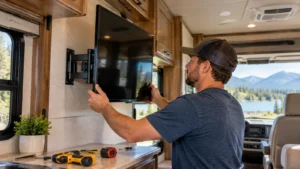
An adjustable mounting arm can be especially convenient in a small RV, allowing you to change the viewing angle when watching from the bed or dining area. However, any mount used in a moving vehicle should be suitable for that application and secured according to the manufacturer’s instructions before travel.
Also consider the television’s overall dimensions and ventilation requirements. A model that technically fits inside a cabinet may still be unsuitable if there isn’t enough clearance around it.
The goal isn’t necessarily to buy the most rugged or expensive television. It’s to choose one with suitable power compatibility, secure mounting options, and practical features for how you use your RV.
Which 12V TVs Are Worth Considering for Your RV?
Once you know your preferred screen size, power requirements, and entertainment features, comparing actual TV models becomes easier. The best option isn’t necessarily the most expensive or feature-packed. A compact smart TV may be ideal for a camper bedroom, while a simpler 12V television could be sufficient if you mainly watch local channels or use a streaming stick.
The following four models from different brands offer practical options for RV owners. Each has a different strength, from modern streaming features to RV-focused construction. The comparison is based on published manufacturer specifications rather than independent hands-on testing.
12V RV TV Models Compared
| Model | Screen Size | DC Power | Resolution | Key Features | Best For |
|---|---|---|---|---|---|
| Sylvox RT24R3KGCA Limo | 24″ | 9–32V | 1920 × 1080 | Smart TV, Wi-Fi, DVD | Compact RV entertainment |
| Free Signal TV FSTV-3222P Transit Platinum | 32″ | 12V DC | Advertised 1080p | Smart TV, Bluetooth, DVD | Larger motorhome lounges |
| Jensen JTV24DC | 24″ | 12V DC | 1920 × 1080 | ATSC tuner, RV-focused construction | Basic TV and local broadcasts |
| Continu.us CT-28T18 Touring Series | 28″ | 12V DC | 720p | HDMI, USB, VESA mounting | Simple RV entertainment setups |
Sylvox RT24R3KGCA — For Compact RV Entertainment
The 24-inch Sylvox Limo is worth considering if you want streaming and DVD playback in one compact television. Its Full HD screen and built-in entertainment features make it suitable for camper bedrooms and smaller living areas. With a manufacturer-rated power consumption below 32W, it’s also a useful candidate for RV owners who need to manage battery usage, although actual consumption varies during operation.
Free Signal TV FSTV-3222P — For Larger Motorhome Lounges
The 32-inch Transit Platinum offers smart entertainment, Bluetooth connectivity, and integrated DVD playback in a larger display. Free Signal TV also emphasizes construction intended for mobile environments. It’s worth comparing if you have enough space for a 32-inch screen and prefer an RV-focused design, although its exact DC input range and native screen resolution should be verified before purchase.
Jensen JTV24DC — For Traditional RV Television Viewing
The Jensen JTV24DC provides a 24-inch Full HD screen with an integrated ATSC tuner for receiving compatible local broadcast channels through an antenna. Its straightforward feature set makes it an option for owners who don’t need built-in streaming apps. Jensen also emphasizes RV-oriented construction, but buyers should confirm current availability and power compatibility for this particular model.
Continu.us CT-28T18 — For Simple Entertainment Setups
The Continu.us Touring Series offers a 28-inch display designed for 12V operation, with HDMI and USB connections for external devices. Its 720p resolution is more modest than the Full HD alternatives, but it may be sufficient for casual viewing. This model is worth considering if you prioritize basic entertainment and a larger screen over advanced smart features, subject to current availability.
Which TV Fits Your Camping Style?
The right choice depends on how you use your RV, not just the number of features listed on the box.
For frequent boondocking: Look for verified DC compatibility and lower power consumption. The compact Sylvox Limo may be worth comparing if you want smart features without a large screen, but battery usage and your RV’s electrical system should guide the final choice.
For small camper bedrooms: A 24-inch model such as the Sylvox Limo or Jensen JTV24DC can be a practical starting point. Choose according to whether you prefer integrated streaming and DVD playback or simpler television viewing with external devices.
For larger motorhome lounges: The 32-inch Free Signal TV Transit Platinum provides more screen space for shared viewing. The 28-inch Continu.us is another option if you prefer a simpler setup, although its lower resolution is an important trade-off.
For budget-focused RV owners: Compare the total cost and the features you’ll actually use. A basic 12V television paired with an existing streaming stick may be sufficient, while a regular household TV can still offer better value if shore power or a suitable inverter is readily available.
Ultimately, the best 12V RV TV is the one that fits your space, electrical system, and viewing habits. Compare verified specifications and total setup costs rather than assuming that more features or a higher price will produce a better camping experience.
RV TV Installation and Everyday Use
Choosing the television is only part of the process. Where and how you install it can make a noticeable difference in daily use, particularly inside a compact RV where seating positions and cabinet space are limited.
Before mounting the screen, check that you can comfortably see it from your usual viewing position. An adjustable VESA arm can make it easier to watch from the bed or dinette, but it must support the TV’s weight and be suitable for a moving vehicle. Follow the mounting manufacturer’s instructions for securing the television before driving, and leave enough clearance for cables and ventilation.
It’s also worth testing your entertainment setup before your first trip. Connect the television to the intended power source, confirm that your streaming apps or external devices work, and check the sound from your normal seating position. Small televisions sometimes have limited built-in speakers, so a compatible external speaker or soundbar may help.
A simple pre-trip checklist can prevent common frustrations:
- Confirm that the TV uses the correct power supply, connector, and cable.
- Secure the television and mounting arm before traveling.
- Test Wi-Fi, HDMI devices, antenna reception, or offline playback options.
- Check sound quality and picture visibility from normal seating positions.
If you frequently move between campgrounds, remember that wireless connections and local TV channels may need updating. Having suitable offline entertainment options can make evenings more enjoyable when campground internet is unreliable.
FAQs
What is the difference between an RV TV and a regular TV?
An RV TV may support direct DC power and include features designed for mobile environments. Regular household TVs generally require AC power. Both can be used in RVs when their power and mounting requirements are met.
Can a 12V TV run directly from an RV battery?
Yes, if the television’s specified DC input range supports your RV’s electrical system. Check the voltage range, connector polarity, and manufacturer instructions before connecting it.
Is a 12V TV more energy-efficient than a 120V TV?
A 12V TV avoids inverter conversion losses when operated from compatible DC power. However, total energy use depends on the television’s wattage and the inverter’s efficiency and operating conditions.
What size 12V TV is best for a motorhome?
A 22–24-inch TV often suits compact bedrooms, while 24–32 inches can work well in larger living areas. Choose based on mounting space, viewing distance, and seating position.
Do you need a smart 12V TV for an RV?
No. A basic 12V TV with HDMI can work with a compatible streaming stick. Built-in smart features are convenient, but local broadcast TV, DVD, or USB playback may be more useful when internet access is limited.