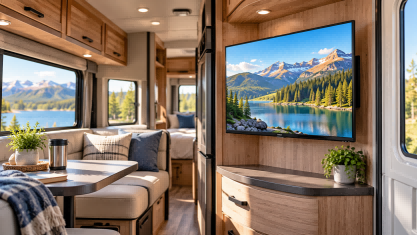
The best TV for an RV depends on how you camp. If you frequently travel off-grid, a dedicated 12V RV TV may be worth the extra cost. If you usually stay at campgrounds with electrical hookups, a regular smart TV can work just as well for much less.
But power isn’t the only consideration. Screen size, secure mounting, and durability also matter when choosing a TV for a motorhome or travel trailer.
This guide compares six of the best TVs for RVs and campers, including dedicated 12V models and budget-friendly smart TVs, to help you choose the right one for your setup.
What Are the Best TVs for RVs and Campers?
The best RV TVs include both dedicated models designed for mobile environments and conventional smart TVs suitable for recreational vehicles with reliable AC power. Neither category is automatically better for everyone.
If you frequently camp off-grid, start with a TV that supports your RV’s DC electrical system. If you primarily use campground hookups, a regular smart TV can provide a larger screen and comparable entertainment features for less money.
Quick Comparison of the Best RV TVs
| Best For | TV Model | Screen | Power Supply | Reference Price |
|---|---|---|---|---|
| Best Dedicated RV TV | Sylvox RT24R3KGCA | 24″ FHD | DC / AC adapter | $319 |
| Best Larger 12V TV | Sylvox RQ32R3KHCA | 32″ FHD QLED | DC / AC adapter | $499 |
| Best Compact AC/DC TV | Supersonic SC-2426SDVD | 24″ HD | 12V DC / AC | $234–260 |
| Best Budget Smart TV | Roku Select 32R3E5 | 32″ FHD | AC-powered setup | $100–150 |
| Best for Larger Motorhomes | Roku Select 40R3E5 | 40″ FHD | AC-powered setup | $150–240 |
| Best Alternative Smart TV | Samsung F6000F | 32″ FHD | 110–120V AC | $178–180 |
Prices are approximate U.S. reference prices from October 2026 and may vary by retailer.
1. Sylvox RT24R3KGCA — Best Dedicated RV TV
The Sylvox RT24R3KGCA is a practical choice for campers who need a compact smart TV with direct DC power compatibility. Its 24-inch Full HD display, Google TV platform, and built-in DVD player make it suitable for smaller RV living areas and bedrooms.
Key Specs: 24″ FHD (1920 × 1080) · 9–32V DC · AC adapter support · Google TV · Below 32W · VESA 100 × 100mm
Pros
- Supports compatible RV battery power without a conventional AC inverter.
- Includes Google TV and DVD playback.
- Manufacturer-reported vibration-tested construction.
Cons
- Significantly more expensive than ordinary 24-inch TVs.
- No independently established durability advantage over household models.
Best for: Frequent off-grid campers who prioritize direct DC operation and compact dimensions.
2. Sylvox RQ32R3KHCA — Best Larger 12V TV
For RV owners who want a larger screen without depending on a conventional AC inverter, the Sylvox RQ32R3KHCA offers a useful combination of display size and DC compatibility.
Its 32-inch Full HD QLED panel, Google TV system, and built-in DVD player make it suitable for larger motorhomes and travel trailers.
Key Specs: 32″ FHD QLED · 10–32V DC · AC adapter support · Google TV · Below 50W · VESA 100 × 100mm
Pros
- Larger screen with direct DC compatibility.
- Integrated smart streaming and DVD playback.
- Designed for mobile applications.
Cons
- Approximately $499, considerably more than conventional 32-inch TVs.
- QLED technology alone does not establish superior measured picture quality.
Best for: Off-grid motorhomes and travel trailers that need a 32-inch television with compatible DC power input.
3. Supersonic SC-2426SDVD — Best Compact AC/DC TV
The Supersonic SC-2426SDVD is an alternative for small campers where flexible power options and offline entertainment matter more than premium resolution.
Its compact display, AC/DC power compatibility, and built-in DVD player make it useful for campground stays and compatible battery-powered installations.
Key Specs: 23.6″ HD (1366 × 768) · 12V DC / AC 100–240V · Smart TV · Built-in DVD · 42W maximum
Pros
- Supports AC and compatible 12V DC power.
- Integrated DVD player and antenna tuner.
- Compact screen suitable for limited spaces.
Cons
- HD resolution rather than Full HD.
- No confirmed RV-specific vibration-test rating.
Best for: Small campers and RV bedrooms where AC/DC flexibility and offline DVD playback are priorities.
4. Roku Select 32R3E5 — Best Budget Smart TV
The Roku Select 32R3E5 offers an affordable option for campers who primarily use shore power or already have a compatible inverter.
Its 32-inch Full HD display, Roku OS, and straightforward streaming interface provide convenient entertainment without the premium associated with dedicated RV televisions.
Key Specs: 32″ FHD · Roku OS · Wi-Fi · Bluetooth · HDMI / USB · VESA 200 × 200mm
Pros
- Affordable 32-inch Full HD display.
- Integrated Roku streaming and voice remote.
- Common connectivity options.
Cons
- Direct 12V compatibility is not documented.
- No manufacturer-documented RV-specific vibration rating.
Best for: Budget-conscious travel trailer owners who usually have access to AC power.
5. Roku Select 40R3E5 — Best TV for Larger Motorhomes
The Roku Select 40R3E5 is worth considering when your motorhome or fifth wheel has enough space for a larger living-area television.
Its 40-inch Full HD display provides more viewing area than compact RV models while retaining Roku’s integrated streaming features.
Key Specs: 40″ FHD · Roku OS · Wi-Fi · Bluetooth · HDMI / USB · VESA 200 × 200mm
Pros
- Larger screen for shared viewing.
- Built-in streaming features.
- Relatively affordable compared with specialized large RV TVs.
Cons
- Requires more mounting space and appropriate structural support.
- Direct 12V operation and RV-specific vibration resistance are not documented.
Best for: Larger motorhomes and fifth wheels with sufficient installation space and suitable AC power.
6. Samsung F6000F — Best Alternative Smart TV
The Samsung F6000F is a conventional 32-inch smart TV for motorhome owners who prefer the Tizen platform and usually have access to AC electricity.
Its official specifications provide clear power consumption and mounting information, making it relatively straightforward to evaluate for an RV installation.
Key Specs: 32″ FHD · 110–120V AC · Tizen · 45W typical / 55W maximum · 8.4 lb without stand · VESA 200 × 200mm
Pros
- Full HD display with integrated smart features.
- Clearly documented operating and standby power consumption.
- Relatively lightweight for its screen size.
Cons
- Cannot operate directly from a standard 12V battery.
- No documented RV-specific vibration rating.
Best for: Motorhome owners who prefer Tizen and generally use shore power or an appropriate inverter.
Do You Need an RV-Specific TV or Will a Regular TV Work?
No, you don’t necessarily need a special TV for an RV. A regular household television can work in a motorhome or travel trailer if its power requirements are compatible, it fits the installation space, and it is securely mounted.
Many RV owners report using ordinary televisions for years, including during frequent travel. However, individual experiences vary, and rough roads can expose weaknesses in mounting hardware or television construction.
RV-Specific vs Regular TVs
| Feature | RV-Specific TV | Regular Household TV |
|---|---|---|
| Power Supply | Often supports direct 12V DC | Usually requires household AC or an appropriate adapter |
| Vibration Resistance | Some models have reinforced construction or manufacturer test claims | RV-specific testing is generally not documented |
| Temperature Tolerance | Some models offer wider published limits | Depends on the model |
| Smart Features | Available on selected models | Wide range of options |
| Price | Often more expensive | Generally more affordable |
| Best For | Off-grid and specialized mobile setups | Shore-power camping and budget-focused installations |
The most meaningful differences are electrical compatibility and specific construction features. An RV label alone does not guarantee longer service life.
When Is an RV-Specific TV Worth the Extra Cost?
A dedicated RV television makes the most sense when you frequently camp without electrical hookups, need a direct-DC installation, or value manufacturer-documented features intended for mobile environments.
For occasional camping at RV parks, a regular smart TV may be perfectly adequate. The price difference can be substantial, particularly when comparing compact dedicated RV TVs with ordinary 32-inch models.
Before paying more, consider whether the additional features solve a problem in your particular setup. Direct DC compatibility, mounting construction, and documented environmental ratings are more meaningful than general claims of ruggedness.
Should You Choose a 12V or 120V TV for Your RV?
Your camping habits should determine which power system you prioritize. A compatible 12V DC TV is convenient for off-grid camping, while a conventional 120V AC television works well with shore power, a generator, or an appropriately sized inverter.
A direct-DC television can avoid the losses associated with converting battery electricity into household AC. However, 12V does not automatically mean lower power consumption. The actual wattage of each television still matters.
For example, the following estimates illustrate electricity use during four hours of viewing:
| Viewing Scenario | Estimated Battery Consumption |
|---|---|
| Sylvox 24″ DC TV, using 32W for planning | Approximately 128Wh |
| Samsung F6000F 32″, 45W typical through an inverter | Approximately 212Wh |
Based on published manufacturer power figures and an assumed 85% overall inverter efficiency. These are calculations, not measured battery-runtime results. The models differ in screen size and rated power conditions.
The comparison demonstrates how television wattage and inverter losses can affect battery consumption. Actual results depend on brightness, playback conditions, battery capacity, and other electrical loads.
| Camping Situation | Recommended Starting Point |
|---|---|
| Frequent boondocking | Compatible 12V DC TV |
| Mostly campground hookups | Regular AC smart TV |
| Mixed shore-power and off-grid use | AC/DC TV or compatible inverter setup |
| Limited budget with reliable AC power | Conventional smart TV |
If your RV already has a suitable inverter, you may not need a dedicated 12V television. When choosing a direct-DC model, always verify its approved input voltage range, connector polarity, and installation requirements.
What Size and Features Should You Look for in an RV TV?
The right TV size depends on viewing distance, installation space, and the strength of the mounting location. A small TV for a motorhome bedroom may be adequate at 24 inches, while a larger motorhome can accommodate a much bigger screen.
Measure the available area before purchasing, including clearance around cabinets, doors, and adjustable mounting arms.
| RV Installation Area | Suggested Screen Size |
|---|---|
| Small camper or bedroom | 19–24 inches |
| Compact travel trailer | 24–32 inches |
| Motorhome living area | 32–43 inches |
| Larger motorhome or fifth wheel | 43 inches or larger |
These ranges are starting points rather than strict limits. Larger televisions can work when the RV has sufficient space and structural support.
Resolution matters, but it shouldn’t dominate the purchase. HD may be adequate for a small bedroom screen, while Full HD offers additional detail. Larger displays or closer viewing positions may benefit from 4K.
Beyond screen size, check the following features:
| Buying Factor | What Matters |
|---|---|
| Power Input | Compatibility with available RV electricity |
| VESA Mounting | Matching mounting-hole pattern |
| TV Weight | Appropriate bracket and wall support |
| Smart Platform | App compatibility and ease of use |
| Connectivity | HDMI, USB, Wi-Fi, Bluetooth |
| OTA Tuner | Local broadcast reception through an antenna |
| Picture and Audio | Brightness, viewing angles, speaker quality |
| Warranty | Coverage and installation restrictions |
For most camper owners, practical compatibility matters more than advanced television specifications. A lightweight Full HD TV with suitable connections may provide better everyday value than a larger, more expensive model that is difficult to install.
RV TV Durability and Travel-Safe Mounting
RV televisions experience road vibration, temperature changes, and repeated movement. Nevertheless, a regular household TV isn’t automatically unsuitable for these conditions.
Some dedicated RV models feature reinforced mounting components, protected circuit boards, or manufacturer-reported vibration testing. Certain products advertise testing at 4g, but without a complete publicly available test procedure, that claim cannot establish superior durability over all household televisions.
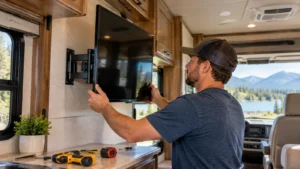
Secure mounting is one of the most important considerations for traveling RVs. VESA compatibility only identifies the mounting interface; it does not certify the complete installation for road vibration. The bracket, fasteners, wall structure, and travel-locking mechanism must all be appropriate for the installation.
Temperature also matters during seasonal storage. A manufacturer’s storage-temperature rating may differ from its operating-temperature rating. Always check the specifications for your exact model rather than assuming that a TV suitable for winter storage can safely operate at the same temperature.
Rapid temperature changes can cause condensation. If moisture may have formed inside or around the TV, allow it to reach suitable operating conditions and dry before switching it on.
The safest approach is to consider both the manufacturer’s documented environmental limits and the quality of the complete installation.
Smart TV Streaming and Offline Viewing in an RV
Smart TVs make entertainment convenient, but the best platform depends on your preferred apps and available internet connection. Roku OS, Google TV, Tizen, and other smart systems offer different interfaces and supported services.
At campgrounds, you may use park Wi-Fi, a mobile hotspot, a cellular router, or satellite internet where service is available. Streaming performance depends on connection quality, so even a capable smart TV may struggle with unreliable internet access.
Built-in smart features reduce the need for additional equipment. However, an external streaming stick can be useful when older TV software no longer supports your preferred applications. Check its power requirements before installation.
An RV TV can also provide entertainment without Wi-Fi. Depending on the model, options include an over-the-air antenna, built-in DVD player, compatible USB media, or previously downloaded content played through a supported device.
For campers who regularly travel outside reliable cellular coverage, these offline options may be more useful than premium streaming features.
Conclusion
The best TV for an RV depends on power availability, screen size, and travel conditions. Dedicated 12V models offer advantages for off-grid camping, while regular smart TVs can deliver better value when AC power is available.
Compare the features you’ll actually use, verify electrical and mounting compatibility, and consider the conditions your television will face. The best RV TV is the one that fits your setup—not necessarily the most expensive model.
FAQs
Can you put a regular TV in a travel trailer?
Yes. A regular TV can work in a travel trailer if its power supply is compatible, it fits the available space, and it is securely installed for travel.
Can you leave a TV in an RV during winter?
Yes, if temperatures remain within the manufacturer’s specified storage range. Avoid operating the TV outside its approved limits, and check for condensation before use.
Can you watch TV in an RV without Wi-Fi?
Yes. Options include local antenna broadcasts, DVDs, compatible USB media, and previously downloaded videos. Availability depends on the television and connected devices.
Is a 24-inch TV big enough for an RV bedroom?
Usually, yes. A 24-inch screen often suits compact RV bedrooms, particularly at shorter viewing distances. Check the mounting space and viewing position before purchasing.
Can you use a regular TV outdoors at a campsite?
A regular indoor TV may be used temporarily in dry, suitable conditions, but it isn’t weatherproof. Permanent outdoor installations require appropriate environmental protection.