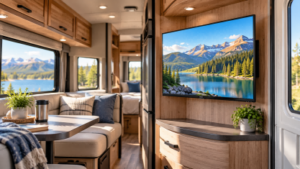
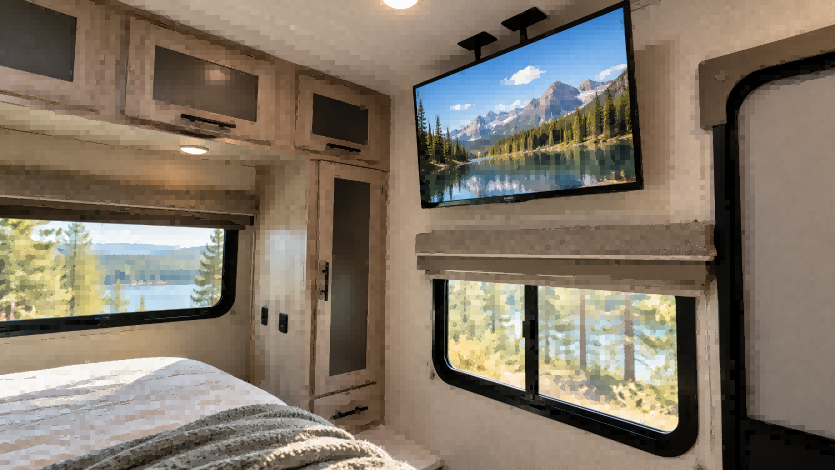
Looking for the best small smart TV for camper and RV use? The Sylvox 24-inch Limo is our top pick for off-grid camping, thanks to its direct 12V power support, 1080p display, and built-in streaming features. For campers with regular electrical hookups, affordable options like the Insignia 24-inch F40 and Roku Select Series may be better choices.
But choosing the right TV isn’t just about brand or screen size. Power compatibility, mounting space, battery consumption, and streaming access all matter when you’re traveling.
In this guide, we compare five small smart TVs for campers and RVs, explain their key differences, and help you choose the best option for your setup.
5 Best Small Smart TVs for Campers and RVs at a Glance
The five televisions below cover different camping needs rather than simply ranking models by price or picture quality. Three support direct DC power, while two are household smart TVs better suited to RVs with available AC electricity.
| Smart TV | Best For | Screen / Resolution | Power Type |
|---|---|---|---|
| Sylvox 24″ Limo RT24R3KGCA | Best Overall RV Smart TV | 24″ / 1080p | DC / AC |
| Sylvox 32″ Limo QLED RQ32R3KHCA | Best for Larger RV Spaces | 32″ / 1080p | DC / AC |
| Supersonic SC-2450GTV | Best Dual-Power Option | 24″ / 768p HD | DC / AC |
| Insignia 24″ F40 NS-24F401NA26 | Best Budget Full HD TV | 24″ / 1080p | Household AC |
| Roku Select 24R2E5 | Best for Easy Streaming | 24″ / 720p | Household AC |
These recommendations are based on product specifications, features, and publicly shared RV ownership experiences rather than independent hands-on testing. The exact model number matters because televisions with similar names can have different resolutions, operating systems, and power requirements.
For frequent boondocking, start with a DC-compatible model. If your camper normally has campground hookups, a conventional smart TV may provide everything you need at a lower price.
5 Best Small Smart TVs for Campers and RVs
1. Sylvox 24-Inch Limo — Best Overall RV Smart TV
The Sylvox 24-inch Limo RT24R3KGCA is our best overall choice for campers who want a compact television designed for RV electrical systems. Its 24-inch Full HD display, direct DC compatibility, smart entertainment features, and built-in DVD player make it particularly suitable for RV bedrooms and smaller living spaces.
The TV supports a wide 9–32V DC input range and can also run on AC power using an adapter. With power consumption rated below 32W, it’s a practical choice for campers who frequently rely on their RV’s house batteries. HDMI, USB, Wi-Fi, and Bluetooth provide flexible connections for streaming and external devices.
| Specification | Details |
|---|---|
| Model | RT24R3KGCA |
| Display | 24-inch, 1920 × 1080 |
| Smart Platform | Google TV |
| DC Input | Nominal 12V, 9–32V range |
| AC Supply | 100–240V via adapter |
| Power Consumption | Rated below 32W |
| Connectivity | HDMI, USB, Wi-Fi, Bluetooth |
| Additional Feature | Built-in DVD player |
The integrated DVD player offers an entertainment option when internet access is unavailable, although it adds thickness compared with televisions without one. At approximately 540 mm wide without its stand, this model can fit many compact RV spaces, but measuring the mounting area before ordering is still essential.
Best for: Campers who regularly travel off-grid and want a compact smart TV without depending on an inverter.
What to consider: Dedicated RV features generally cost more than comparable household TVs. If you rarely use battery power, a less expensive AC model may offer better value.
2. Sylvox 32-Inch Limo QLED — Best for Larger RV Spaces
The Sylvox 32-inch Limo QLED RQ32R3KHCA provides a larger viewing area while retaining direct DC compatibility. It’s a suitable option for motorhome lounges, larger travel trailers, or campers with enough wall space for a 32-inch television.
This model combines a Full HD QLED display with Google TV and a built-in DVD player. It supports a 10–32V DC input range, with power consumption rated below 50W. This makes it worth considering for larger RVs that still rely on battery power.
| Specification | Details |
|---|---|
| Model | RQ32R3KHCA |
| Display | 32-inch QLED, 1920 × 1080 |
| Smart Platform | Google TV |
| DC Input | Nominal 12V, 10–32V range |
| AC Supply | 100–240V via adapter |
| Power Consumption | Rated below 50W |
| Additional Feature | Built-in DVD player |
The larger screen makes group viewing more comfortable, especially when the TV is installed across from a dinette or seating area. However, it also requires more mounting clearance and potentially more battery energy than a smaller model.
QLED describes the display technology, not the resolution. This television is Full HD rather than 4K, so its main advantage over the 24-inch model is its larger viewing area.
Best for: RV owners who want a bigger screen while maintaining direct DC power compatibility.
What to consider: Make sure the mounting location can accommodate its dimensions and weight. The higher rated power limit also deserves attention when planning off-grid battery usage.
3. Supersonic SC-2450GTV — Best Dual-Power Smart TV
The Supersonic SC-2450GTV is a versatile choice for campers who alternate between campground electricity and RV battery power. Its 24-inch display fits many compact interiors, while AC/DC compatibility makes it useful for different camping setups.
The TV features a 1366 × 768 HD display and Android TV for accessing streaming applications. With three HDMI ports, two USB ports, and Ethernet connectivity, it can accommodate several entertainment devices without constant cable swapping. It also supports 12V DC and 110–240V AC power, with a maximum rated consumption of 36W.
| Specification | Details |
|---|---|
| Model | SC-2450GTV |
| Display | 24-inch, 1366 × 768 |
| Smart Platform | Android TV |
| Power Input | 12V DC / 110–240V AC |
| Maximum Consumption | 36W |
| Connectivity | 3 HDMI, 2 USB, Wi-Fi, Ethernet |
| Additional Feature | Anti-glare display |
Its multiple HDMI connections are useful when connecting a streaming stick, laptop, or RV entertainment system. The anti-glare display can also help reduce distracting reflections in camper interiors with nearby windows.
The biggest compromise is its lower resolution compared with the Sylvox 24-inch Limo. Also, confirm which power cables are included, since compatible DC accessories may need to be purchased separately.
Best for: Campers who regularly switch between hookups and off-grid power and value flexible connectivity.
What to consider: AC/DC compatibility does not automatically mean the TV supports simultaneous power connections or automatic switching. Follow the instructions for the exact model.
4. Insignia 24-Inch F40 — Best Budget Full HD Smart TV
The Insignia 24-inch F40 NS-24F401NA26 is a budget-friendly alternative for RV owners who usually camp with electrical hookups. Instead of paying extra for specialized RV power features, buyers get a compact Full HD television with built-in Fire TV functionality.
Its 1920 × 1080 display provides sharper image detail than many entry-level 720p televisions, especially when viewed from a short distance. Fire TV gives users access to popular streaming applications, while the Alexa Voice Remote makes navigation and content searches convenient.
| Specification | Details |
|---|---|
| Model | NS-24F401NA26 |
| Display | 24-inch, 1920 × 1080 |
| Smart Platform | Fire TV |
| Voice Control | Alexa Voice Remote |
| Power Category | Household AC |
| Direct 12V Compatibility | Not established |
| Main Advantage | Affordable Full HD streaming |
This makes the F40 particularly suitable for camper bedrooms where viewers sit relatively close to the screen. Its compact dimensions also make it worth considering when replacing an older small television.
Unlike dedicated 12V models, this is a household TV, so plan to use a suitable AC outlet rather than connecting it directly to your RV’s battery system.
Best for: Budget-conscious RV owners who primarily stay at campgrounds with electrical hookups.
What to consider: Confirm the exact electrical rating, physical dimensions, and mounting requirements before purchasing.
5. Roku 24-Inch Select Series — Best for Easy Streaming
The Roku Select Series 24R2E5 is a practical choice for buyers who prioritize straightforward streaming and simple everyday operation. Its compact 24-inch HD display works well in smaller RV spaces, while the integrated Roku operating system provides an easy way to browse streaming services.
The TV includes dual-band Wi-Fi, Bluetooth functionality, a voice remote, and HDMI connections for external devices. It also supports a 200 × 200 mm VESA mounting pattern, an important detail when checking compatibility with an existing TV bracket.
| Specification | Details |
|---|---|
| Model | 24R2E5 |
| Display | 24-inch, 720p HD |
| Smart Platform | Roku OS |
| Wireless | Dual-band Wi-Fi, Bluetooth |
| Connectivity | HDMI, USB, antenna input |
| VESA Mount | 200 × 200 mm |
| Power Category | Household AC |
Roku’s familiar interface makes it appealing to RV owners who want to start watching without adding another streaming device. Bluetooth headphone functionality is also convenient in compact living spaces where one person may want to watch TV quietly.
Its main limitation is resolution. Compared with the 1080p Insignia F40, the Roku offers less picture detail. However, viewers who prioritize a familiar streaming experience may find that trade-off acceptable.
Best for: Campers who mainly use shore power and want a straightforward streaming television.
What to consider: This model is not established as directly compatible with RV battery power. Use an appropriate AC supply and confirm mounting compatibility before installation.
Should You Choose a 12V RV TV or a Regular Smart TV?
A 12V RV TV is generally more convenient for frequent off-grid camping, while a regular household smart TV often offers better value when shore power is available. Both types can work well in a camper, but their electrical requirements are different.
The right choice depends on whether you usually camp with hookups, rely on house batteries, or already have an inverter installed. A dedicated RV label alone doesn’t guarantee better value or durability.
12V RV TVs for Off-Grid Camping
A dedicated 12V television can operate from a compatible RV DC power circuit without first converting battery electricity into 120V AC. This eliminates the need to run an inverter solely for the television and can reduce unnecessary conversion losses.
However, RV batteries do not maintain exactly 12V under every operating condition. Their voltage changes during charging and discharging, so the television must support the actual DC voltage range provided by the electrical system. Properly protected wiring and compatible connectors are equally important.
For frequent boondocking, a DC-compatible television such as the Sylvox 24-inch Limo is a practical starting point.
Regular Smart TVs and Dual-Power Options
A regular household smart TV can work in an RV when supplied with the correct AC electricity. This makes budget-friendly models such as the Insignia F40 and Roku Select attractive for campers who usually stay at powered campsites.
During off-grid trips, an AC television generally requires an inverter or another suitable AC power source. If your RV already operates an inverter for other appliances, using a household TV may be more economical than purchasing a dedicated RV model.
An AC/DC television offers a middle ground for campers who alternate between hookups and battery power.
| Camping Setup | Recommended TV Type | Main Advantage |
|---|---|---|
| Frequent boondocking | Direct DC Smart TV | Avoids running an inverter solely for TV |
| Mostly campground hookups | Regular AC Smart TV | Often lower purchase cost |
| Mixed off-grid and hookup camping | AC/DC Smart TV | Flexible power options |
| Existing inverter setup | Compatible AC Smart TV | Can use existing electrical equipment |
Ultimately, the best choice is the television that matches your RV’s electrical setup without requiring unnecessary equipment or expense.
What Size Smart TV Is Best for a Camper?
For most compact campers and travel trailers, a 24-inch smart TV offers a practical balance between viewing comfort and installation space. Smaller 19–22-inch models work well in narrow bedrooms or cabinets, while 28–32-inch televisions are better suited to larger RV living areas.
Screen size refers to the diagonal measurement, not the television’s actual width. Even two TVs with the same screen size may have different cabinet dimensions, bezels, or rear connections.
| Screen Size | Recommended Space | Main Consideration |
|---|---|---|
| 19–22 inches | Compact campers and narrow bedrooms | Minimal space requirements |
| 24 inches | Camper bedrooms and small travel trailers | Balanced viewing and installation |
| 28–32 inches | Larger travel trailers and motorhomes | More viewing area and mounting clearance |
Viewing distance also matters. A Full HD screen can display sharper menus, subtitles, and image details than a comparable 720p panel when viewed up close, although the difference becomes less noticeable farther away.
Before ordering, measure the available width, height, and depth, including room for ventilation, cables, and swivel-mount movement. The best size is one that fits comfortably without obstructing movement or compromising installation safety.
How Much Power Does a Small RV TV Use?
A small smart TV generally consumes less electricity than a large television, but actual power usage varies with screen brightness, operating conditions, and the model itself. For campers using house batteries, knowing the TV’s wattage helps estimate how long it can operate off-grid.
The Sylvox 24-inch Limo is rated to consume less than 32W, compared with less than 50W for the 32-inch Limo QLED. These figures can help estimate battery needs, although actual power use will vary with viewing conditions.
You can estimate electricity consumption using two simple formulas:
Energy (Wh) = Power (W) × Viewing Hours
Current (A) = Battery-Side Power (W) ÷ Battery Voltage (V)
For AC televisions running through an inverter, battery-side power also depends on conversion efficiency.
| Example | Assumed TV Load | Battery-Side Power | Energy for 4 Hours |
|---|---|---|---|
| 24-inch TV, direct DC | 32W | 32W | 128Wh |
| 32-inch TV, direct DC | 50W | 50W | 200Wh |
| 32W AC load through an 85%-efficient inverter | 32W | 37.6W | 151Wh |
| 50W AC load through an 85%-efficient inverter | 50W | 58.8W | 235Wh |
These estimates are for planning purposes. Actual battery use will also depend on other RV appliances, wiring losses, and inverter overhead.
For example, a battery with 500Wh of usable energy could theoretically power a steady 32W load for approximately 15.6 hours if no other appliances were running. Actual viewing time may be shorter.
Also, remember that an adapter’s maximum output rating is not the same as the TV’s power consumption. A 12V/6A adapter has a rated capacity of 72W, but the connected television may use considerably less.
RV TV Durability and Mounting Considerations
Camper televisions experience vibration, road movement, and changing temperatures. However, a dedicated RV television is not automatically more durable than every household model. Construction quality, mounting arrangements, and travel conditions all influence long-term reliability.
Some RV-specific models feature reinforced frames, vibration-resistant designs, coated circuit boards, or wider operating-temperature ranges. These features can be useful for frequent travelers, but not every RV-branded TV offers the same level of protection. Check the manufacturer’s durability claims and warranty coverage rather than relying solely on labels such as “RV-grade” or “shock-resistant.”
Many RV owners also report using ordinary household televisions successfully over several years. Some prefer securing the TV with a locking mount, while others remove it during travel. These experiences suggest that proper installation matters, although individual reports cannot establish comparative failure rates.
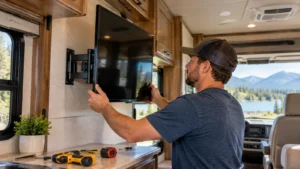
Before mounting a television, verify the VESA pattern, bracket weight capacity, and RV wall attachment points. RV walls may require designated reinforced mounting locations rather than ordinary household installation methods.
A locking or properly secured mount can reduce unwanted movement during travel. Follow the TV, mount, and RV manufacturer’s instructions for securing equipment while driving, and make sure power cables cannot pull against the television.
Smart TV Features and Connectivity
A good camper smart TV should make everyday entertainment convenient without requiring a complicated setup. Google TV, Roku OS, Fire TV, and Android TV provide access to streaming applications, although supported apps, system responsiveness, and software features vary by model.
Internet access is particularly important when camping. Streaming services typically need a reliable connection through campground Wi-Fi, a mobile hotspot, or another internet service. When connectivity is unavailable, compatible antenna broadcasts, HDMI devices, supported USB media files, or DVD playback can provide alternative entertainment.
Connectivity matters as well. HDMI ports allow you to connect streaming sticks, laptops, or external media players, while Bluetooth can be useful for headphones and wireless speakers. HDMI ARC or eARC may simplify audio connections when both devices support the feature.
For smaller TVs, a 1080p display generally provides sharper detail than a similar 720p screen, particularly at close viewing distances. However, picture resolution shouldn’t outweigh electrical compatibility, installation fit, or the streaming features you actually use.
Final Recommendation
The Sylvox 24-inch Limo is our overall recommendation for campers who need direct DC power and compact entertainment features. For larger RV spaces, the Sylvox 32-inch Limo QLED offers more viewing area without sacrificing DC compatibility.
The Supersonic SC-2450GTV is worth considering for mixed AC/DC use, while the Insignia F40 and Roku Select provide affordable alternatives for campers who mainly rely on shore power.
Before buying, confirm the exact model, power requirements, mounting dimensions, and available installation space. The best small smart TV is ultimately the one that fits your camper and how you travel.
FAQs
What kind of TV is best for a camper?
A compact LED smart TV with compatible power input and secure mounting is usually the best choice. Frequent off-grid campers should prioritize direct DC compatibility, while travelers using campground hookups can consider regular household smart TVs.
Can you connect a regular smart TV directly to a 12V RV battery?
Only if the manufacturer specifies a compatible DC input range. A low-voltage power adapter does not automatically establish battery compatibility. Never connect a television directly to an RV battery without verifying voltage, polarity, connectors, and protection requirements.
Can a regular TV survive the vibrations of RV travel?
Yes, many RV owners successfully use household televisions. However, durability depends on the television, installation, travel conditions, and proper securing during transportation. A stable, appropriately rated mount is essential.
Do smart TVs work without Wi-Fi in a camper?
Yes, but internet-dependent streaming apps generally will not function offline. You can still use compatible HDMI devices, antenna broadcasts, DVD playback, or supported USB media files without campground Wi-Fi.
Is 720p good enough for a 24-inch RV TV?
Yes, 720p can be sufficient for casual viewing, particularly from a greater distance. However, a 1080p display provides more detail and may be preferable for close-up viewing, menus, subtitles, and computer use.